
Chess of the Gnostics (Mystics’ Chess)
London
$1,500
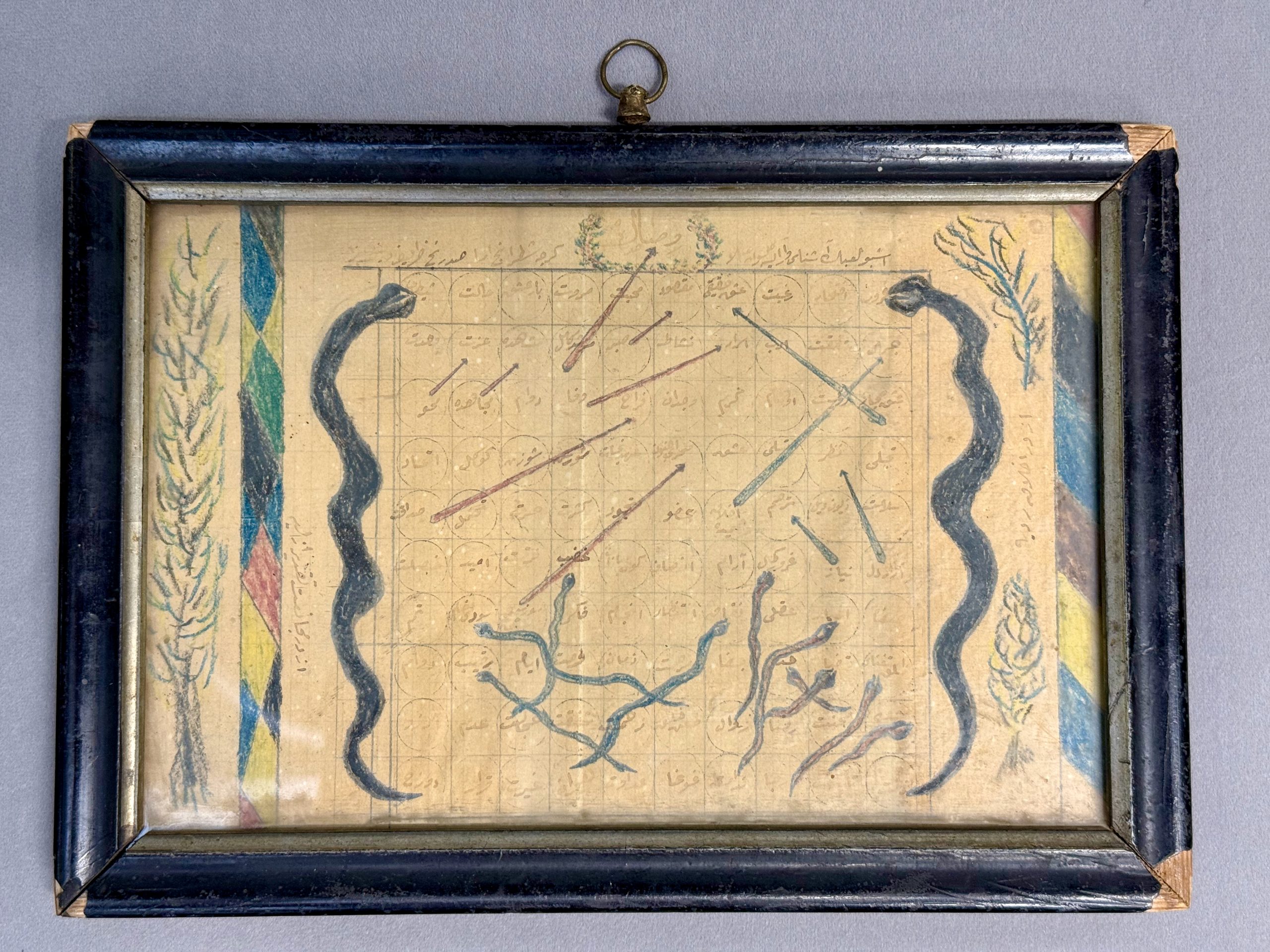
Satranç-ı Urefa (Chess of the Gnostics / Mystics’ Chess)
Sufi Folk Art – Tekke Work
Early 20th century, Ottoman Empire or Early Republican Turkey
Paint on paper (exact pigment undetermined)
A rare and evocative example of Sufi folk art, this hand-drawn “Satranç-ı Urefa” (Chess of the Gnostics) is a mystical board game used as an allegorical teaching tool. Rooted in Islamic spirituality, this early version of what later evolved into games like Snakes and Ladders reflects the Sufi path toward divine unity (tawhid), using numbered spaces and symbolic “ascents” and “descents” to represent the soul’s journey through spiritual states.
The concept is thought to have originated or been adapted in the Islamic world as early as the 16th–17th century, associated in some sources with Ahmad al-Maqqari (1578–1632), although its Anatolian versions became more widespread through Bektashi, Mevlevi, and other Sufi orders in the 18th and 19th centuries. By the early 20th century, such boards were often handmade by dervishes or lay practitioners in tekke environments (Sufi lodges), blending spiritual teaching with the aesthetics of everyday devotion.
The gameboard uses squares to represent spiritual stations or states (maqams, ahwal), with pathways that mirror moral progress or setbacks. “Ladders” symbolize the aid of grace or right conduct; “descents” indicate temptations or spiritual distractions.
This piece is made with paint on paper, employing modest materials in keeping with the spirit of tekke craftsmanship: devotional, contemplative, and didactic rather than decorative alone.
Satranç-ı Urefa represents a remarkable convergence of gameplay, mysticism, and pedagogy, embodying how popular Sufi culture translated complex metaphysical ideas into accessible, everyday forms. Its rarity today reflects the decline of tekke culture following the closure of Sufi institutions in early Republican Turkey (1925), making such items valuable both as artifacts of religious history and as expressions of visual folk culture.
Hand-painted board with age-appropriate wear, light creasing, and edge toning. Colors and inscriptions remain vivid and legible. A well-preserved example of this disappearing cultural form.